
Understanding aviation jargon is crucial for anyone in the field. This bilingual guide covers key regulators and common flight terms used in Saudi Arabia and worldwide, with Arabic translations. It’s aimed at students, entry-level staff, and seasoned professionals in the MENA region. We explain each term clearly and provide references for further reading.
Regulatory Bodies (الهيئات الرقابية)
GACA – General Authority of Civil Aviation (Saudi Arabia, الهيئة العامة للطيران المدني). GACA is the national regulator of Saudi civil aviation . It oversees safety, licensing, and airport operations.
GACAR – General Authority of Civil Aviation Regulations (Saudi regulations, لوائح الهيئة العامة للطيران المدني). GACAR is the regulatory framework issued by GACA for flight operations and maintenance in Saudi Arabia . It replaces many older U.S. rules.
FAA – Federal Aviation Administration (United States, الإدارة الفدرالية للطيران). The FAA is the U.S. civil aviation authority, responsible for aviation safety, air traffic control, and aircraft certification .
ICAO – International Civil Aviation Organization (منظمة الطيران المدني الدولي). ICAO is a UN agency that sets international air navigation standards. It helps 193 countries cooperate on aviation safety and share airspace .
IATA – International Air Transport Association (الاتحاد الدولي للنقل الجوي). IATA is the global trade association for airlines (over 350 carriers), setting technical standards and best practices for airline operations .
EASA – European Union Aviation Safety Agency (وكالة سلامة الطيران الأوروبية). EASA regulates aviation safety and standards within the European Union .
Other national authorities: Most countries have a Civil Aviation Authority (CAA). For example, the UAE’s regulator is GCAA (General Civil Aviation Authority), الهيئة العامة للطيران المدني , and Egypt’s is the Egyptian CAA (هيئة الطيران المدني المصرية).
These bodies coordinate through ICAO and regional agencies (e.g. the Arab Civil Aviation Commission) to ensure uniform aviation rules.
Flight Operations & Rules (عمليات الطيران والقواعد)
Pilots navigate under Visual Flight Rules (VFR) or Instrument Flight Rules (IFR) depending on weather. VFR (قواعد الطيران المرئي) means flying with clear visibility by looking outside, following landmarks. VFR applies in good weather and does not require special clearance; pilots “see and avoid” other traffic . When weather is poor (IMC), IFR (قواعد الطيران الآلي) is used: pilots rely on cockpit instruments for navigation and must file an IFR flight plan . Under IFR, air traffic control assigns altitudes and routes.
VFR (قواعد الطيران المرئي) – Set of rules for flying in good visibility . Pilots use visual landmarks and are responsible for keeping safe separation from other aircraft. VFR flight is generally not assigned specific routes or altitudes by ATC.
IFR (قواعد الطيران الآلي) – Rules for flying in instrument meteorological conditions . Aircraft navigate by instruments and must maintain ATC separation. IFR requires pilot and aircraft certification (instrument rating) and filing a flight plan.
Air Traffic Control (ATC) – مراقبة الحركة الجوية. Ground-based controllers direct aircraft on runways and in controlled airspace, preventing collisions and managing traffic flow . ATC issues clearances, handles takeoff/landing sequencing, and provides en-route guidance.
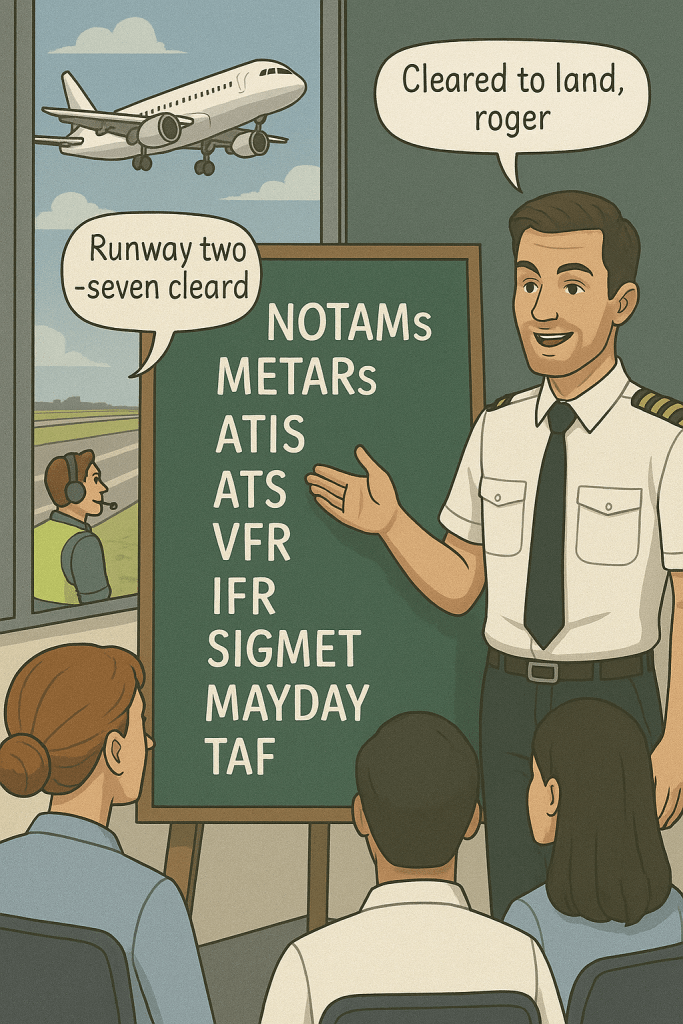
Common flight terms (with Arabic): Heading – اتجاه الطائرة, Altitude – ارتفاع الطائرة. Pilots and controllers also use emergency calls like “Mayday” (استغاثة) for distress. The figure above highlights some basic terms in English and Arabic.
Weather & Communication (الأحوال الجوية والاتصالات)
METAR (تقرير حالة الطقس الدوري) – Meteorological Aerodrome Report. A standardized weather observation broadcast (usually hourly) from airports . METARs include wind, visibility, clouds, temperature, etc. Pilots and meteorologists use METAR data for pre-flight briefings and forecasts.
TAF (تقرير الطقس التنبؤي) – Terminal Aerodrome Forecast. Like METAR, but a forecast covering a 6–30 hour period. (Arabic: تقرير التنبؤات الجوية.)
SIGMET (تحذير جوي) – Significant Meteorological Information. Urgent warnings about severe weather (e.g. thunderstorms, icing). (Arabic: إشارات جوية مهمة.)
NOTAM (إشعار إلى الطيارين) – Notice to Airmen. An advisory filed with aviation authorities to alert pilots of hazards or changes (e.g. closed runways, navigation outages) that could affect a flight . NOTAMs ensure timely information about any alterations to airport or airway conditions.
ATIS (خدمة معلومات المطار الآلية) – Automatic Terminal Information Service. A continuous recorded broadcast at busier airports providing current weather, active runway, and airport information to arriving/departing aircraft . Pilots listen to ATIS (identified by a letter code) before contacting tower, reducing radio congestion.
Communications (الاتصالات الجوية) – ICAO mandates that ATC communications be in English or the local language . In practice, controllers in Saudi and international flights use English phraseology (ICAO-standard). Routine terms include “Cleared for takeoff” (أُذن بالإقلاع) or “Cleared to land” (أُذن بالهبوط).
Pilots use the abbreviations and jargon above daily. For example, on pre-flight they check NOTAMs, METARs, and listen to ATIS for runway and weather updates. In flight, they coordinate with ATC via radio (English phraseology) and follow VFR/IFR rules as required by conditions.
Sources: Official aviation authorities and reference guides .
 Main Page
Leave a comment